What is the best fabric for hiking pants?
For many lightweight and all-season hiking pants, a polyester-spandex or nylon-spandex stretch woven fabric is a practical starting point. Polyester can support quick-drying, dimensionally stable and commercially versatile programs; nylon is often considered for a soft hand and high strength at lower weight. The weave, fabric weight, stretch recovery and finishing are more decisive than the fiber name alone.
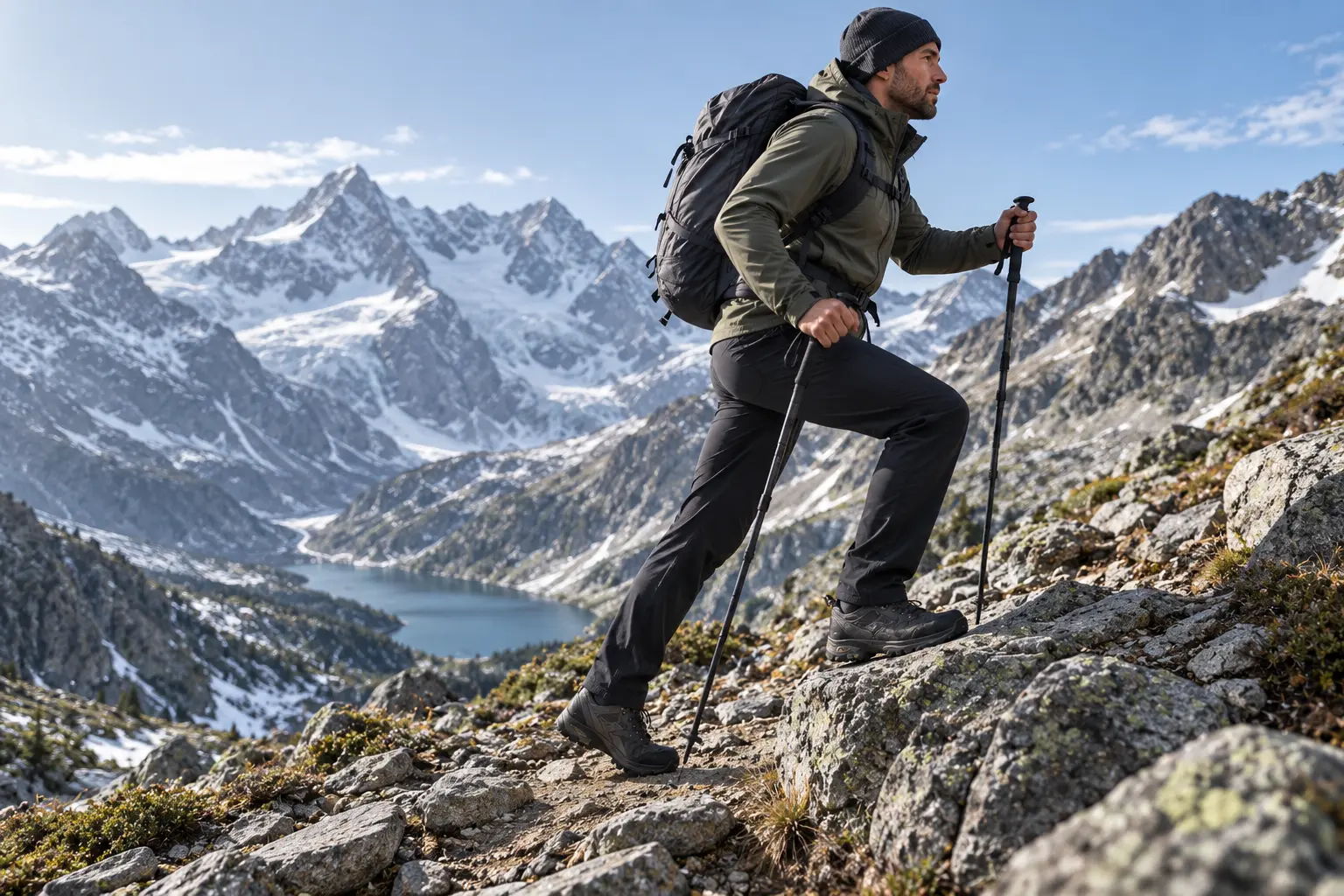
Hiking pants need to flex through repeated steps, climbs, squats and long periods of sitting. At the same time, the fabric may contact rock, brush, rain and pack straps. The best starting point depends on whether the garment is a light summer trouser, an all-season trekking pant or a weather-protective alpine style.
Define temperature range, expected activity level and silhouette before choosing composition. A slim climbing pant normally needs different stretch and recovery from a relaxed travel trouser, even if both use polyester-based woven fabric.
Spandex stretch or mechanical stretch?
| Route | Advantages | Points to confirm |
|---|---|---|
| Polyester-spandex | Direct elasticity, strong mobility, broad 2-way and 4-way options | Spandex percentage, heat response, recovery and long-term bagging |
| Mechanical stretch polyester | Stretch created by yarn and structure; useful for mono-material briefs | Actual movement range, directional stretch and recovery after wear |
| Bonded stretch fabric | Can add warmth, body or weather protection | Total weight, backing, breathability and seam bulk |
Choose weight together with construction
Lower-GSM fabrics can support hot-weather comfort and packability, but they may require a dense weave or selected yarn to reach the desired durability. Medium weights often balance coverage, structure and year-round use. Heavier bonded options can suit cool-weather trekking but may trap too much heat in high-output conditions.
Do not compare GSM alone. Hold the fabric against light, stretch it in both directions and evaluate recovery. Check whether the face snags easily and whether the fabric becomes transparent over bent knees.
Recovery is as important as stretch percentage
A fabric can feel highly elastic during a hand pull but still recover poorly. In finished pants, weak recovery appears as bagging at knees, seat and hips. Ask for stretch and recovery results using the intended test method, then repeat the assessment after washing and heat exposure if the garment will be tumble-dried or industrially finished.
Pattern engineering also matters. Moderate two-way stretch aligned across the body may perform well when the pattern includes articulated knees and a gusset. Four-way stretch provides broader movement but is not automatically necessary for every product.
How to compare stretch percentage and recovery
| Result pattern | What it can indicate | Buyer action |
|---|---|---|
| Higher stretch with strong recovery | Broad movement with the fabric returning close to its original dimensions | Confirm repeated-cycle and after-wash results before approval |
| Higher stretch with weak recovery | Comfort during extension but a greater risk of knee or seat bagging | Do not approve from hand feel alone; review recovery and garment trials |
| Moderate stretch with strong recovery | Controlled mobility and shape retention | Consider for trekking pants with articulated knees or a gusset |
| Low stretch with stable dimensions | Structured appearance but less movement allowance | Check whether pattern ease or mechanical stretch is sufficient |
Questions buyers ask about hiking-pants stretch
- Is a higher spandex percentage always better? No. Yarn, weave, finishing and heat history influence the finished fabric, so composition alone cannot predict movement or recovery.
- Is four-way stretch necessary? Not always. Well-oriented two-way stretch can work for many trekking trousers when the garment pattern supports movement.
- Why should recovery be checked after washing? Heat and laundering can change elasticity, dimensions and surface appearance, making after-care results more useful than an initial hand pull.
- Can one recovery value guarantee no knee bagging? No. Fabric results, pattern shape, garment fit, seam construction and repeated wear all contribute to the final outcome.
Add only the functions the user needs
- Durable water repellency for light rain, wet vegetation and splashes.
- Quick-drying performance for travel and high-output activity.
- Abrasion-resistant weave or yarn selection for rock and brush contact.
- UPF development for exposed warm-weather hiking programs.
- Brushed or bonded backings for cooler climates.
- Membrane lamination when wind or waterproof protection is a defined priority.
What to test on the shortlisted fabric
Common evaluations include dimensional stability, colorfastness, stretch and recovery, pilling, snagging, tear strength and abrasion. Water repellency, hydrostatic pressure or moisture-vapor testing should be added only when those claims are part of the brief. Test methods and pass levels should be agreed before bulk production.
A wear prototype remains valuable. Ask wearers to climb steps, squat, kneel and walk with a loaded pack. Observe waistband recovery, knee bagging, inner-thigh friction and drying comfort after activity.
A complete inquiry saves sampling time
- Garment drawing or reference photo and intended market.
- Preferred composition, weight range, usable width and stretch direction.
- Target hand feel, surface texture and color standard.
- Required finishing and test methods.
- Estimated order quantity, color split and launch date.
- Whether an existing reference should be matched or a new construction developed.